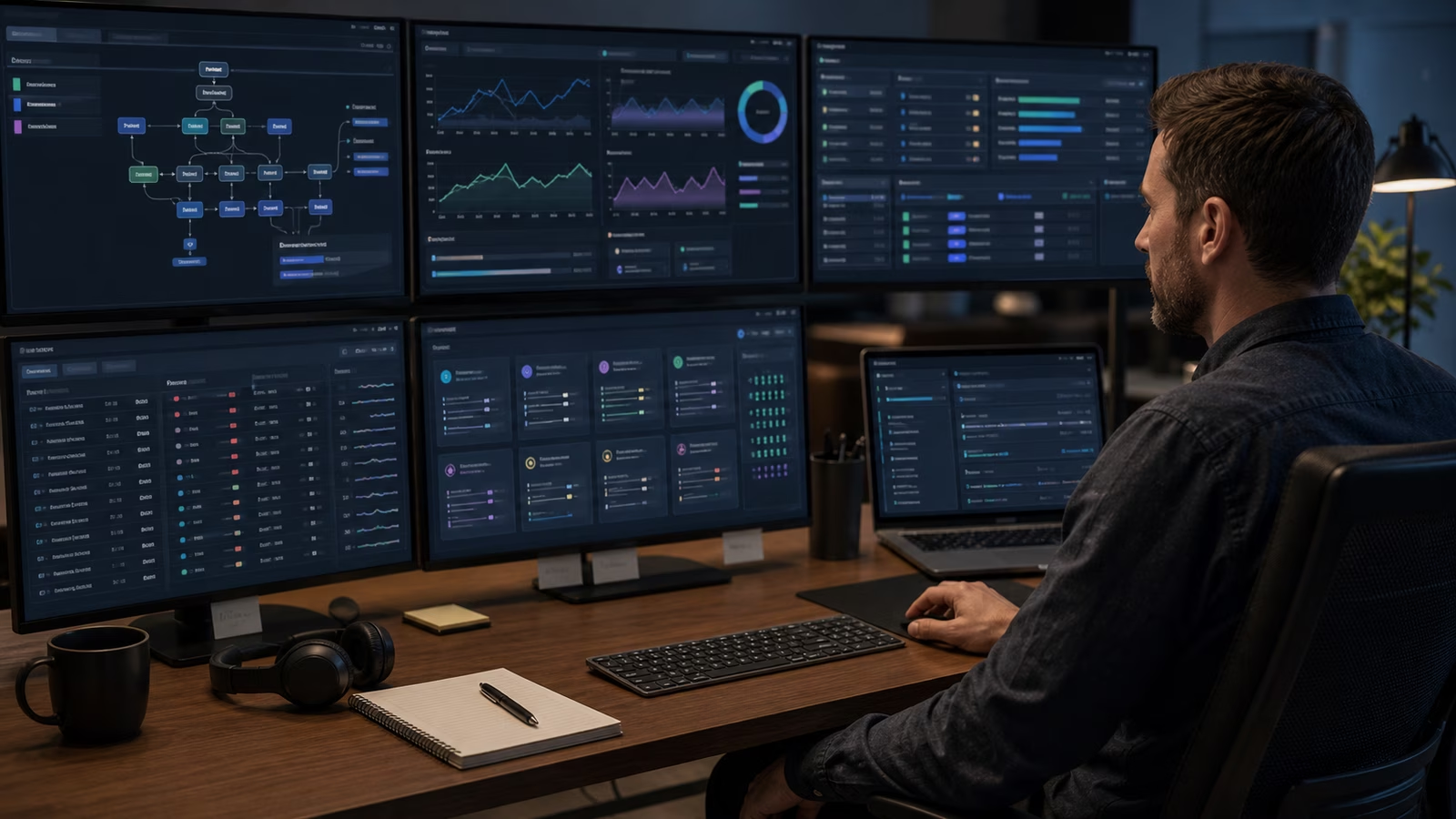
AI agents are often described as if delegation were free once the workflow exists. A person gives the assignment, the agent goes off, tools get called, files get read, a result appears, and the human moves on to something more important. That picture is useful for imagination, but it leaves out the operating budget that decides whether agents are practical at scale.
The budget is not only money. It is time, attention, tokens, tool calls, retries, human review, queue pressure, permission delays, context loading, failed attempts, and the cost of cleaning up when a delegate misunderstood the job. An agent that looks impressive in a demo may become frustrating in daily work if every run is slow, expensive, noisy, and hard to inspect. An agent that looks modest may become valuable if it finishes predictable work with controlled cost and a review surface that respects human time.
Cost and latency are not side issues. They shape what kind of work should be delegated, how the agent should be scoped, and how much autonomy it should have. If the task is urgent, slow deliberation may be unacceptable. If the task is cheap but frequent, a few extra model calls per run may become real spend. If the task requires human review every time, the bottleneck may move from execution to approval. The agent did not remove the workflow; it changed where the workflow waits.
The First Cost Is Understanding the Task
Every agent run begins by building enough context to act. That may mean reading the prompt, loading project instructions, scanning files, checking tickets, reading logs, opening browser pages, querying a database, or retrieving memory. This context gathering can be the most valuable part of the work, but it is not free. It consumes time and model attention before the agent has changed anything.
This is why vague delegation is expensive. A request such as “fix the report” may force the agent to infer which report, what is wrong, what standard applies, who the audience is, and whether edits are allowed. A clearer request narrows the search. It tells the agent where to look, what counts as success, what not to touch, and when to ask before acting. The cost difference between those two prompts may not show up as a line item, but it appears in runtime, retries, and review burden.
Good agent operations treat context as a working set, not a pile. The agent should see enough to make decisions, but not so much that it spends the run swimming through irrelevant material. That is why runbooks, task templates, and tool contracts matter. They help the delegate start with the right frame instead of rediscovering the shape of the job every time.
Latency Changes the Feel of Delegation
Latency is not only the number of seconds before a response appears. It is the human experience of waiting. A person will tolerate a long run if the work is clearly substantial, progress is visible, and the result is trustworthy. The same person may lose patience with a shorter run if the system seems stuck, silent, or likely to return something that needs heavy correction.
Agent latency has several layers. The model may need time to reason. Tools may be slow. Network calls may block. Search may return too much. File reads may be cheap individually but expensive in quantity. Approval gates may pause the run. Human review may add hours or days if the reviewer is unavailable. A workflow that looks automated can still spend most of its life waiting in queues.
The useful question is not simply how to make every run faster. The better question is what latency the task can tolerate. A background research sweep can take longer if it leaves useful notes and evidence. A customer support draft may need to return quickly but remain within a narrow permission boundary. A code modification may take minutes, then require tests. A production incident delegate may need to gather evidence quickly and avoid speculative changes.
When latency expectations are explicit, the agent can be designed around them. Some tasks should favor a smaller model, a narrower search, and a fast draft. Some deserve a slower, more careful pass. Some should be split so the first result arrives quickly while deeper analysis continues in the background.
Queues Reveal the Real Bottleneck
One agent run is a task. Many agent runs become an operations system. When several people delegate work, queues form. There may be a queue for agent execution, a queue for tool access, a queue for expensive model calls, a queue for human review, a queue for deployment, and a queue for exceptions. The system is only as fast as the slowest important queue.
This is where organizations can fool themselves. They see agents completing tasks and assume capacity has increased cleanly. Then reviewers become overloaded. Security approvals pile up. Agents create more draft work than humans can inspect. Duplicate runs compete for the same data. A team has more output, but not more finished work.
Queue design is a discipline of honesty. If every agent output needs human signoff, the review queue must be treated as part of the product. If only risky outputs need review, the rules that separate routine work from risky work must be clear. If agents can launch long-running jobs, there must be a way to cancel, prioritize, and avoid waste. If several agents can touch related systems, their work needs ordering and conflict detection.
The worst queue is the hidden one. A person thinks the agent is working, but it is waiting for a permission, blocked on a tool, retrying a bad call, or producing output nobody will review. Good traces and status updates are not decoration. They prevent silent work from becoming silent waste.
Retries Are Part of the Budget
Agent failures are often counted after the fact, but retries should be part of the expected cost. A delegate may call the wrong tool, search the wrong files, misunderstand a constraint, produce a draft that needs revision, hit a rate limit, or discover that the task was impossible as written. Some retry is normal. Too much retry is a design smell.
The key is to distinguish useful retry from blind persistence. Useful retry happens after new evidence appears. The agent tried one approach, found a failing test, read the relevant error, and adjusted. Blind persistence repeats variations without learning. It consumes budget while creating the impression of effort.
Guardrails help here. A run can have a maximum number of expensive calls, a time box, a rule for when to ask for clarification, and a requirement to leave evidence if it stops. Those limits do not make the agent weaker. They make the operating cost predictable. A person would not want a junior colleague to spend three days guessing in silence. An agent should not be allowed to do the machine version of that either.
Human Review Has a Cost Shape
Human review is often described as the safe fallback, which is true, but it is not free. A review that requires reading the entire output, reconstructing the agent’s reasoning, checking every source, running tests, and guessing what changed may cost as much as doing the task manually. A review that presents a clear summary, diff, evidence trail, risk notes, and known gaps may be much cheaper.
The same agent result can therefore have different real costs depending on the review surface. A polished paragraph without citations may be expensive to trust. A rougher draft with clear sources may be cheaper. A code change with passing tests and a focused diff may be easier to approve than a larger, more impressive patch that touches unrelated files.
Teams should measure review time, not just agent time. If agents save execution time but double review time, the workflow may still be worth it for some tasks, but the economics are different. The goal is not to remove humans from every decision. The goal is to reserve human attention for the decisions that matter.
Cost Discipline Makes Agents More Useful
The practical future of agents will not belong only to the most capable model on the longest leash. It will belong to systems that choose the right level of effort for the job. A tiny task should not summon a sprawling research agent. A high-risk task should not be rushed through a cheap shortcut. A repeated workflow should get a runbook, budget limits, and clear evaluation. A one-off exploration can tolerate more wandering if the result is learning.
This is why cost, latency, and queues belong in the same conversation as safety and capability. They decide whether delegation becomes a daily habit or an occasional stunt. People will use agents more when the work returns on time, within budget, with enough evidence to review. They will use them less when every request becomes a slow, expensive mystery.
An agent is not only a model with tools. It is a worker inside an operating system. That system has wait times, failure modes, review gates, budgets, and human patience. The teams that understand those costs will build agents that feel less magical and more dependable. That is the version worth wanting.