An AI agent can have a careful prompt, a narrow toolset, a sensible memory policy, and a good evaluation suite, then still feel unreliable because the human has no clear place to look. The agent disappears into a run, produces a final answer, and leaves the person to infer what happened from a polished summary. That is not a mature delegation experience. It is a black box with manners.
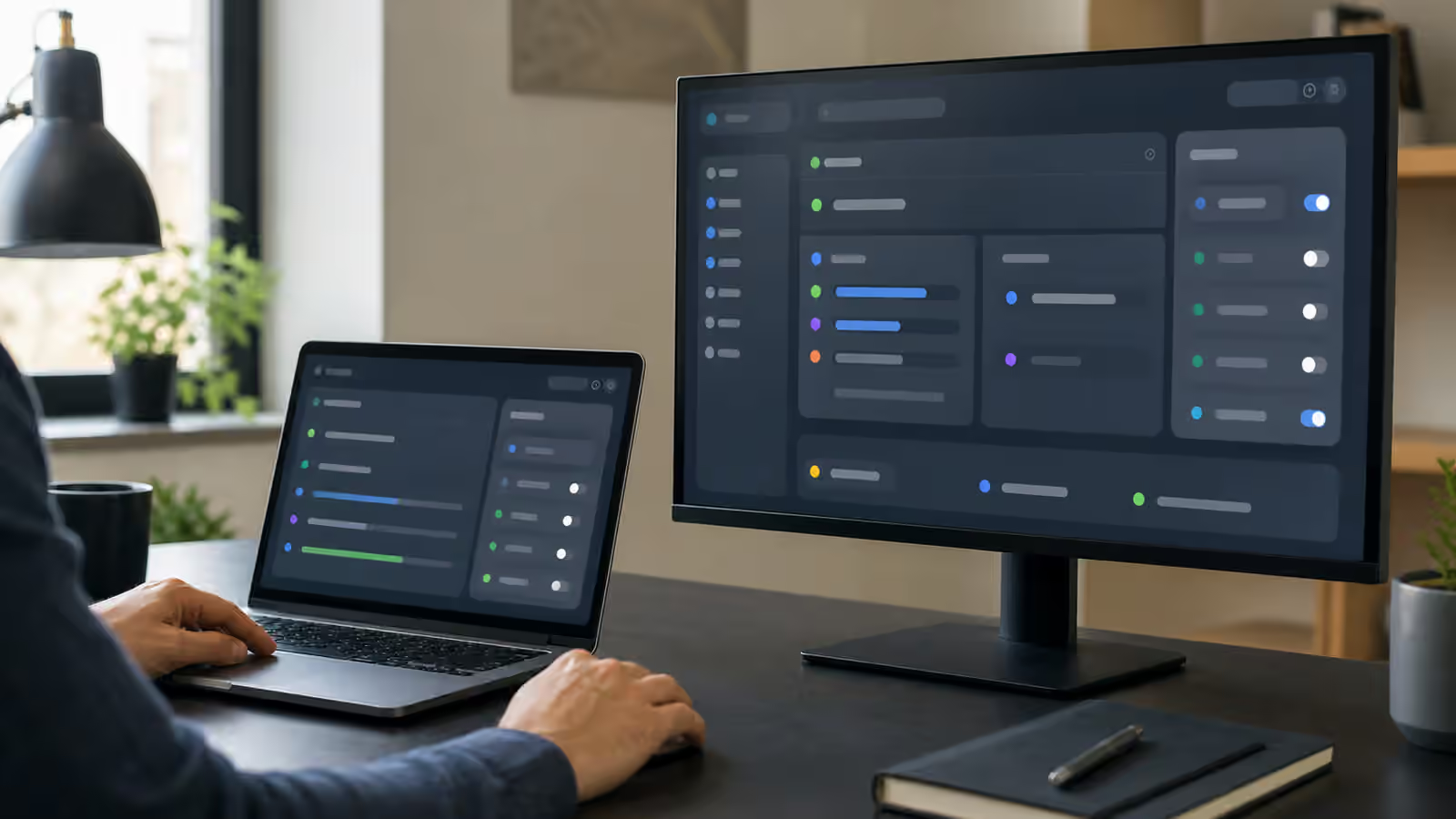
A control surface is the part of the agent system that makes delegated work visible and governable while it is happening. It is not only a dashboard, and it is not only a chat transcript. It is the working interface where a person can see state, inspect evidence, approve actions, pause a run, resume from a checkpoint, compare output against the original assignment, and understand which permissions are active. The control surface is where architecture becomes supervision.
This topic sits close to AI Agent Observability and Human Review for AI Agents , but it is not the same thing. Observability records what happened. Human review decides whether the work should be accepted. The control surface is the place where those ideas are made usable. It decides what is shown by default, what is hidden behind detail, what requires attention, and what can safely remain quiet.
The interface begins before the run
Many agent interfaces treat the assignment box as an empty field waiting for a request. That is fine for casual chat, but weak for delegated work. A serious control surface begins before the agent starts by making the shape of the task visible. The human should be able to see the goal, the allowed tools, the scope boundary, the expected artifact, and the stop conditions before the run begins.
This does not mean burying the user in configuration. The interface can remain simple while still making the important boundaries explicit. If the agent is allowed to read a repository but not write files, that should be visible before launch. If it may draft a customer reply but not send it, the send boundary should not be discovered later. If it should use a specific knowledge base, the source of truth should be attached to the assignment rather than implied by conversation history.
The point is to prevent a common failure: the agent and the human begin with different ideas of the job. A chat box invites vague delegation. A control surface should turn the assignment into a small operating contract. That contract connects naturally to AI Agent Tool Contracts because tools are not just capabilities. They are promises about what can be done, what will be returned, and what evidence will remain after the action.
State should be legible without pretending certainty
People supervising agents need to know what state the work is in. Not every task is either running or done. A run may be reading sources, waiting on a tool, blocked by missing access, ready for approval, validating a change, holding a draft, or stopped after a failed check. Those states should have names the human can understand without reading the transcript.
The hard part is showing state without turning it into theater. A lively stream of tiny status messages can make the system look busy while saying very little. A silent spinner is worse because it hides whether the agent is making progress, waiting, looping, or stuck. The useful middle ground is state that maps to operational meaning. If a run is blocked, the interface should say what decision, source, credential, or artifact is blocking it. If a run is validating, the interface should show what is being checked. If a run is done, it should distinguish finished draft from accepted work.
This is where AI Agent Checkpoints become visible to the user. A checkpoint buried in logs is technically present but operationally weak. A checkpoint shown as a stable state gives the human a place to resume, review, or hand off the task. The interface should make interruption feel normal rather than catastrophic.
Approval controls must name the consequence
The most dangerous button in an agent interface is the vague approval. A button that says approve may mean accept the plan, allow file edits, grant access, send a message, publish a change, run a migration, or spend money. If the interface does not name the consequence, the person may approve one thing while the agent proceeds as if another thing was approved.
A good control surface makes authority concrete. The approval should be attached to the action, the artifact, and the boundary. Approving a draft means the draft is acceptable for the next step. Approving a tool call means a specific tool may run with specific inputs. Approving a message means the message, recipient, and sending identity are all in scope. Approving a code change means the files, branch, checks, and merge path are clear enough for the reviewer to judge.
This connects directly to AI Agent Permissions . Permission design is often discussed as a backend rule, but the human experiences it as an interface. If the screen does not show which ladder rung the agent is on, the permission model becomes invisible. Invisible permission models invite mistakes because people cannot easily tell when the agent has moved from reading to acting.
Approval controls should also show reversibility. A reversible formatting change and an irreversible deletion do not deserve the same interaction. The interface does not need to dramatize risk, but it should change the amount of attention required when the consequence changes. The more durable the action, the more the control surface should slow the hand and sharpen the evidence.
Evidence belongs near decisions
Agent systems often keep evidence somewhere else: in traces, source links, logs, artifacts, or a long answer below the fold. That may be enough for audit, but it is not enough for review. When a person has to decide whether to accept a recommendation, approve an action, or resume a run, the most relevant evidence should be close to the decision.
For research work, that might mean showing the sources that support the answer and the sources that were rejected as stale or irrelevant. For code work, it might mean changed files, test commands, and failing checks. For operations work, it might mean record counts, policy references, and before-and-after summaries. The exact evidence depends on the task, but the placement principle is stable: decisions should not float away from proof.
This does not mean exposing every event by default. A full trace can be essential when debugging, but it is usually too dense for ordinary review. The control surface should present evidence at a useful altitude, then let the reviewer descend into details when something feels off. A reviewer deciding whether to approve a customer reply should not have to read every retrieval event, but they should be able to see the policy, the customer facts used, and the sentence where the agent made an inference.
Good evidence placement also changes the tone of supervision. Without evidence, the person is asked to trust a fluent output. With evidence, the person can inspect a narrow path. That is the practical difference between a control surface and a prettier transcript.
Interruption is a feature
Agent interfaces often optimize for completion, but real delegated work needs interruption. A person may notice a bad assumption, a risky action, a missing source, a tool failure, or a change in priority. The interface should make it easy to pause without destroying the run and easy to resume without pretending nothing happened.
The pause control should preserve state. If the agent is halfway through a comparison, the pause should keep the assignment, sources inspected, artifacts produced, decisions made, and open questions. A stop that leaves only a final transcript makes future work expensive. A stop that creates a checkpoint keeps the work reusable.
Interruption also needs a correction path. If the human changes the assignment, the interface should make that change visible as part of the task history. The agent should not silently blend the old and new instructions into a confusing compromise. A corrected boundary, a newly approved tool, or a revised definition of done should become part of the working state.
This matters more as teams use coordinated agents. In a multi-agent workflow, one delegate may research, another may edit, and another may validate. The control surface should show ownership and handoff state clearly enough that people do not confuse parallel motion with coordinated progress. AI Agent Coordination depends on this kind of visible boundary because shared work fails when everyone sees activity but nobody sees responsibility.
The surface should respect privacy and attention
A control surface can easily become too revealing. If it exposes every private document, every prompt, every customer record, and every tool output to every reviewer, it may reduce one risk while creating another. Human visibility is necessary, but it should follow the same data boundaries as the rest of the system.
The interface should show enough for accountability without copying sensitive material into places it does not belong. A reviewer may need to know that the agent used a restricted document, but not see the full document. A manager may need to see that an approval happened, but not the private content behind it. A support lead may need record identifiers and policy references, while a broader audit surface may need only the shape of the run.
Attention is another boundary. If the control surface highlights everything, it highlights nothing. Warnings should mean something. Required approvals should be distinct from optional review. Failed checks should be easier to notice than routine progress. The interface should protect the human from both hidden risk and pointless noise.
Design for the next reviewer
The person who starts an agent run is not always the person who finishes it. A teammate may take over after a queue delay. A manager may inspect the work after a customer complaint. An engineer may debug the run after a failed deployment. A future version of the same user may return tomorrow and need to remember why the work stopped.
That means the control surface should be designed for continuity. It should preserve the original assignment, current state, evidence, artifacts, approvals, skipped checks, and remaining uncertainty in a form someone else can understand. This is not extra documentation after the work. It is part of the work.
A good surface also helps the agent behave better. When the interface asks the agent to produce inspectable state, name decisions, attach evidence, and separate drafts from actions, it encourages cleaner runs. The agent learns, through the workflow, that fluent completion is not the only goal. Legible progress matters.
That is the deeper value of a control surface. It is not decoration around an agent. It is the place where delegation becomes accountable. It gives the human enough information to supervise without doing the whole task again. It gives the agent a structure for pausing, asking, proving, and handing off. It gives the organization a shared view of what delegated work means before, during, and after the run.
AI agents become more useful when people can see the right parts of their work at the right time. Not every trace needs to be on screen. Not every decision needs a modal. Not every task needs a command center. But every serious agent workflow needs a surface where state, evidence, permission, and consequence meet. Without that surface, the system may still be powerful. It will just be harder to trust, harder to repair, and harder to use responsibly.